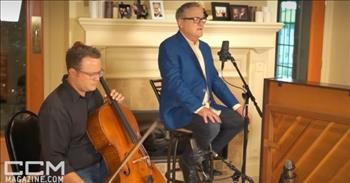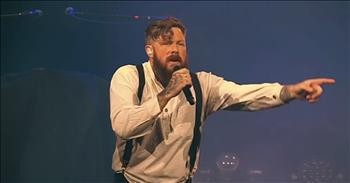







Recording a song the caliber of “My Savior, My God” can
be a mixed blessing. Just ask worship leader, Aaron Shust.
The simple tune he penned for his local congregation took
radio by storm, topping six different charts at once while
on its way to becoming the most played song of 2006 on
the Christian Adult Contemporary charts. From his debut
project, Anything Worth Saying, “My Savior, My God” helped
earn Aaron a trio of Dove Awards for “Song of the Year,”
“Songwriter of the Year,” and “New Artist of the Year.”
It also propelled the Georgia-based worship leader into
the spotlight and onto the road in a whirlwind of concerts
and promotional tours, sharing the stage with the likes of
superstars MercyMe, Bebo Norman, Casting Crowns, Michael
W. Smith, Jeremy Camp, Brandon Heath, and TobyMac, in
between his own headline stints. A scant year later, Aaron
released his hotly anticipated follow-up, Whispered and
Shouted, an album informed by his desire to create music
that would minister to people outside the four walls of his
church. A full-bodied, open-hearted album of breathtaking
beauty and scope, Whispered and Shouted flung its message
of hope across the highways and byways with a compelling
mixture of swelling strings and quiet ruminations.
Two years have passed since Aaron released Whispered and
Shouted. Marketing pundits would call that a lifetime in
an industry that lives and dies by the next radio hit. But
rather than acquiescing to the voices clamoring for ‘more,’
Aaron chose to listen to the voice encouraging ‘better.’ And
if ‘better ’ required additional time for songs to gestate, so
be it.
That’s not to say Aaron has been sitting on his hands for
the past two years. On the contrary, there have been no dull
moments for Aaron Shust. His roles include the increasing
demands of fatherhood (two boys ages 2_ years and 6
months), constant interaction with fans during and after
his concerts, and ministry opportunities at his home church
and with international relief organization Compassion
International. Alongside all this, Aaron was determined to
make his next album the most intense, honest, and cohesive
of his career. One listen will convince even the most jaded
critic that he has succeeded.
With Take Over, Aaron Shust ups the musical ante by
stripping the songs down to their bare bones and offering
them without extraneous embellishment or anything to hide
behind. They are the kind of songs that creep up on you
when you least expect it, nestle between your ears, and
make themselves at home in your heart.
“I see Take Over as an album about submission,” Aaron says.
“Its central theme might be surrender, a relinquishing of
control. A common thread that shows up in a lot of these
songs is one of admitting that it is not from our own efforts
that we can achieve anything. Certainly we can’t achieve
salvation. We can work out our salvation but it is only
through what Christ has done on the cross that we have
any hope.”
Co-produced by the team of Jason Ingram and Rusty
Varenkamp (Bebo Norman, Meredith Andrews, 10th Avenue
North, Rush of Fools), Take Over finds Aaron reaching
deeper and wider for both musical and lyrical inspiration.
To get it, he partnered with some of the most respected
songsmiths in the industry, including Brandon Heath, Matt
Bronleewe, Ian Eskelin, Matthew West, Doug McKelvey, and
Jason Ingram. As an artist who had always written his own
songs, Aaron says the experience humbled him, stretched
him, and helped him to rediscover himself as a songwriter.
“I wanted really excellent songwriting for this project.
Songwriting is hard work. It doesn’t come easily for me. To
be able to sit in a room with Jason, or Ian, or Brandon and
create music that touches people’s souls was a privilege.”
The hard work of creating songs paid off. Take Over is a
project of rare aesthetic beauty coupled with a refined
and intentional foundation. It is at once classic and
contemporary, ranging from pensive and introspective to
exuberant, communal rock ‘n’ roll.
“We blew out all the stops on Whispered and Shouted,” he
explains. “For Take Over, I wanted to scale it back, to simplify
the production to the basics — drums, bass, electric guitar,
acoustic, maybe a piano. The production was really simple,
but solid. Every part had a purpose.”
The sparse instrumentation proved to be a watershed decision
as the focus became more intentional on the songwriting.
While some artists opt for poetic turns of phrase or catchy
hooks that sound great but leave listeners wondering what
it all means, Aaron is more interested in making sure his
lyrics are straightforward and understandable.
“I think every artist struggles with how to construct an album
that is completely cohesive, yet still takes you on a real
journey,” Aaron explains. “Because life is a journey, even
when it doesn’t feel particularly cohesive.
“It all goes back to the worship leader in me that wants to
engage my listeners in an experience that will impact their
lives. I wanted to create an album experience that starts
with a bang, gives them a little rest in the middle, and then
ramps it up at the end. I wanted it to be a rollercoaster with
the ups and downs, highs and lows. I think there are songs
that work when you are sitting down in your living room on
a quiet summer evening, and then there are songs that work
on your morning drive.”
Take Over boasts straight up, raucous rock songs like “Come
and Save Us,” with its thundering bass, undergirding drums,
and dichotomous message that is at once an anguished cry
for mercy and a triumphant shout of victory. But it also
has theologically-informed contemporary hymns like “To
God Alone” and “Forevermore” that will no doubt take
their places in worship services around the world. And of
course, it has songs that are classic Aaron Shust, like the
celebratory pop anthem “When Everything is Beautiful.”
“There’s a difference between being a worship leader in
church on Sunday morning and being a worship artist in
concert on Thursday night,” Aaron muses. “When I lead
worship at church, it’s my job to lead the congregation in
songs that point their hearts and minds toward God, toward
His worth and His holiness. There is a holiness that I
want to be felt on Sunday morning. But, even in a concert
situation where people are paying for a ticket to come hear
me sing, ultimately, I am still singing songs that point to
the glory and worth of God. There are still moments of
congregational worship when I step off the microphone and
allow the audience to lift their voices and sing. I love those
moments of community.”
For Aaron Shust, it is those moments when the music moves
us to set our own wills aside and let God Take Over that
make it all worthwhile.